

A beautiful landscape is a healthy landscape – let’s clear Gorenjska (Upper Carniola) of invasive species!
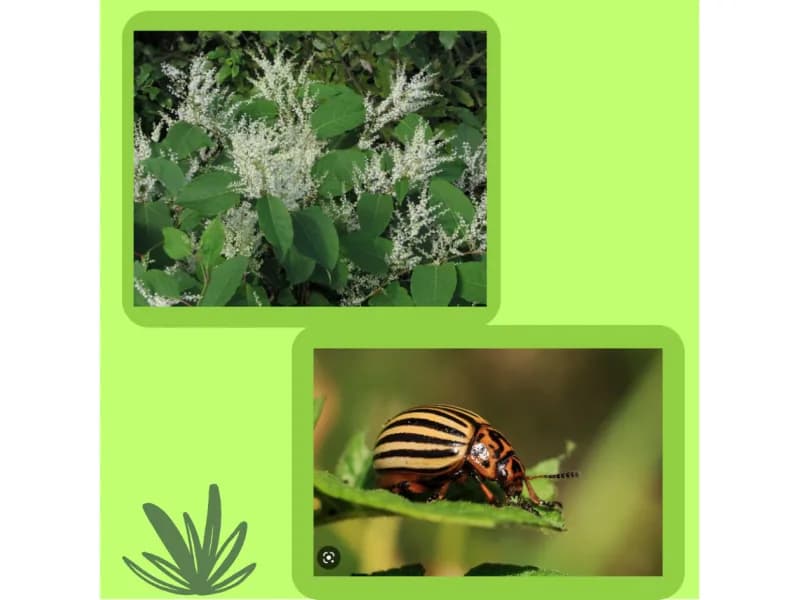
These are troublesome and persistent plants (such as amaranths, common ragweed, Japanese knotweed, etc.) and pests (such as the Colorado potato beetle, western corn rootworm, Spanish slug, chestnut gall wasp, fireblight, etc.).
• They reduce yields and increase production costs due to greater use of plant protection products or more labour.
• They change the appearance of the landscape.
• They displace native plants and animals and alter ecosystems.
• They cause allergies (ragweed in particular) or have other adverse effects on health (giant hogweed, for example).
• They cause damage to buildings and structures.
• They reduce flood safety and increase erosion.
• They block access to water.
• They increase the cost of maintaining roads, railways and other public areas.
• Altogether, these problems cost European Union countries around €12 billion every year.
WHAT CAN YOU DO?
- They need to be removed as soon as possible, or their spread must be prevented.
- The safest way to deal with invasive alien plant waste is incineration, which is essential for plants that are flowering or setting seed. However, the waste can also be handled in other ways: ragweed, goldenrod, Himalayan balsam and American pokeweed that are not yet in flower can be composted on site – but this certainly does not apply to Japanese knotweed.
You can read more about handling invasive alien plant waste in the document available at https://zrsvn-varstvonarave.si/wp-content/uploads/2020/08/Ravnanje-z-ostanki-ITR-kon%C4%8Dna.pdf (opens in a new tab)).
- Garden green waste must never be dumped in the forest, as this introduces alien species into the natural environment, from where they spread on their own.
- Their spread can also be limited by mowing the plants before they flower – indeed, the period before flowering is the key guideline for any kind of removal.
- To prevent new species from being introduced into our surroundings, we can do a great deal by learning about invasive alien species and by using and planting native plants in our gardens. Invasive alien plants quickly escape from our gardens, as their seeds are often spread by the wind or their fruit is carried off by birds.
- Early detection and knowledge of their distribution are vital for the effective management of invasive alien species, so we invite everyone to report sightings of invasive species to the “Invazivke” system run by the Slovenian Forestry Institute – the mobile app is available on Google Play and the App Store.
Everyone can help to control invasive alien species!
You can find out more about invasive species and how to dispose of them properly here: https://skp.si/download/invazivke-brosura-splet-spreds-pdf?ind=60c31c20982c4&filename=Invazivke-brosura-SPLET-spreds.pdf&wpdmdl=6197&refresh=640da94287ff41678616898 (opens in a new tab)
The map was produced by ZRSVN (Institute of the Republic of Slovenia for Nature Conservation), and the data on the locations of invasive alien species was obtained from the website www.invazivke.si.